
Where vendor cost actually sits
When a localisation manager is asked to cut vendor spend, the first lever that comes to mind is the rate. Ask for a lower price per minute, or find someone cheaper. We have run vendor work at Linearis in Tallinn for years, and in our experience that lever is the weakest one. A specialist who is paid less per minute does not work faster. They take on more jobs to make up the difference, and the quality of attention falls.
When we looked at what a subtitle job really cost us, the rate was only the visible part. The larger part was time. Hours of specialist work per episode, because the starting draft needed rebuilding rather than refining. Rework, because the brief was in one email and the reference file in another. Re-sends, because the vendor had worked on a copy that was already out of date. Licences for tools priced per person. And waiting, on both sides: the vendor waiting for a file or an answer, the producer waiting for a status update.
None of those costs appears as a line on the vendor’s invoice, but all of them end up in it, or in our own overhead. The argument of this post is simple. If you remove the time a vendor spends on things that are not their craft, the job costs less and the vendor is not worse off. Often they are better off, because they can take on more work at the same rate.

- 01 / DRAFTPrepare
- 02 / VERSIONAssign
- 03 / PORTALTrack
- 04 / SUBMITReceive
Start the vendor from a better draft
The biggest single factor in a specialist’s time is the quality of what they start from. A vendor who receives a rough transcript with drifting timing spends the first hour on mechanics: splitting lines, fixing timing, correcting names they had to look up. That is paid specialist time spent on work a machine can do.
In clipsubs the first pass is prepared before the vendor is involved. Transcription runs in 99 languages with word-level timing, and automatic timing cleanup and smart line breaking shape the draft into subtitles rather than a block of text. If the project has a termbase, names, brands and specialist vocabulary are recognised during transcription, so the vendor is not correcting the same surname in every episode. Each termbase list holds up to 100 terms, and vendors can add terms to the project’s termbase from the editor, so the next episode starts with what this one taught them.
The draft is still a draft. The specialist listens, reads and decides, and that is the work we want to pay for. What changes is that their hours go into meaning, tone and readability instead of into rebuilding structure.
“A vendor should be paid for judgement. Every minute they spend fixing mechanics is a minute we are both paying for something else.”
Lauris Zemturis, founder of clipsubs
Assign one exact version, with the brief attached
Rework usually starts with ambiguity. Which file is the right one, which reading speed the client wants, whether speaker names are in or out. In the old way of working, the brief, the file and the deadline travelled separately. The vendor pieced them together and sometimes pieced them together wrongly.
An assignment in clipsubs carries all of it. You choose the specific language version, not a file exported from it, and add a deadline and a note with the instructions. You set task permissions for import, auto-fix, translation and QC, so the specialist has the tools the job needs. If a vendor works in more than one language, a single assignment can cover several language versions, each with its own permissions.
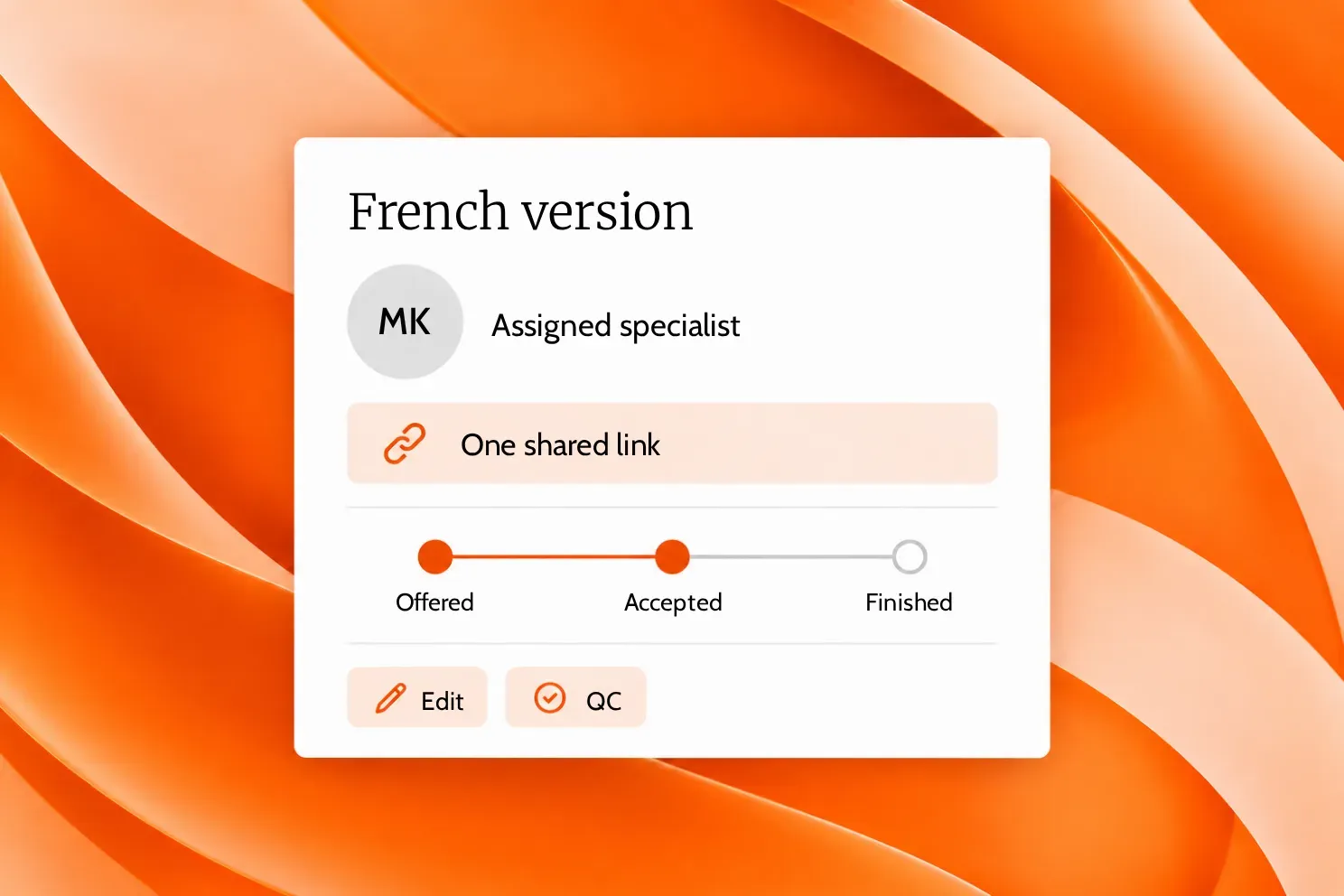
Because the vendor works on the version itself, there is no question of which copy is current. When they finish, the work is already in the project, grouped by language with the latest marked. Nothing has to be renamed, re-imported or compared against an older export, and nobody on our side spends an hour reconciling two files.
Give the AI allowance a size
Vendors increasingly use AI tools on their side, and that creates a hidden cost of its own: tools the vendor pays for and passes on, or processing done outside the project where nobody can see the result. We wanted the vendor to have AI inside the job, with a budget the manager can see.
Every assignment carries an AI allowance. The default is 15 minutes, which covers small tasks. Editing, in-editor translation and QC are free, so a vendor refining a translated version may never touch the allowance. If the task includes resyncing a track, size the allowance to the media: AI Resync uses 0.3× the duration, so a 60-minute episode needs 18 minutes. The vendor can also choose to use their own hours instead of the organisation’s, which suits specialists who work for several clients and prefer to manage their own processing.
The point is not to restrict the vendor. It is to make AI processing a planned cost on the assignment rather than a surprise on someone’s card.
Before you send the next assignment
- Check that the draft was transcribed with the project termbase.
- Choose the exact language version and write the note as if no email will follow.
- Set permissions for import, auto-fix, translation and QC to match the task.
- Size the AI allowance from the work, not from habit.
Let the portal do the chasing
Waiting is the cost nobody invoices. In our old workflow a producer could spend a good part of the day asking the same questions: did you get the file, have you started, when will it be done. Each of those messages also interrupted a specialist who was trying to work.
Specialists in clipsubs work through a vendor portal. They receive an invitation by email, and the assignment moves from offered to accepted to finished. Managers get an email when a vendor accepts or rejects the work, and the manager dashboard shows each vendor’s status. Partial submissions let a specialist hand in finished versions before the whole job is complete, so review can start on the first languages while the rest are still in progress.
Status should be something you look at, not something you ask for.
Stop paying for seats and re-sends
The vendors who touch a project change from job to job. One series needs a Finnish specialist this month and a Polish one next month. If every collaborator needs a paid seat, a team either pays for people who are not working or falls back to emailing files, and that brings back the re-sends and the version confusion.
Team workspaces in clipsubs have no seat limits, and external specialists do not need a paid seat at all. What you pay for is AI processing, from a shared pool of hours. That puts the cost where the work is. A vendor who joins for one assignment costs nothing to add, and the hours they use are the hours you allowed on the assignment.
“We did not want a pricing model that made it cheaper to email a file than to invite the person who needs it.”
Lauris Zemturis, founder of clipsubs
What changed in our own work
We tested this on ourselves before we offered it to anyone. In Linearis’s own back-catalogue work, a one-hour episode used to take 4 to 5 hours of specialist time with the old tool chain of separate tools for transcription, editing, file transfer and tracking. With clipsubs the same kind of episode now takes up to about 1.5 hours. That is roughly four times faster, at the same quality, and our vendor costs are lower.
The rate did not fall. The time did. Our specialists spend their hours on listening and deciding, and much less on rebuilding drafts, hunting for files and answering status questions. That is our own experience on our own catalogue, not an industry benchmark, and your numbers will depend on your material and your vendors.
If you want to try the same exercise, take one recent job and list every hour a vendor spent on it. Mark which hours went into the language work and which went into everything around it. The second list is where the saving is, and you can take it without asking anyone to work for less.
“Lower cost and a fair rate are not opposites. The waste was always in the handoffs.”
Lauris Zemturis, founder of clipsubs